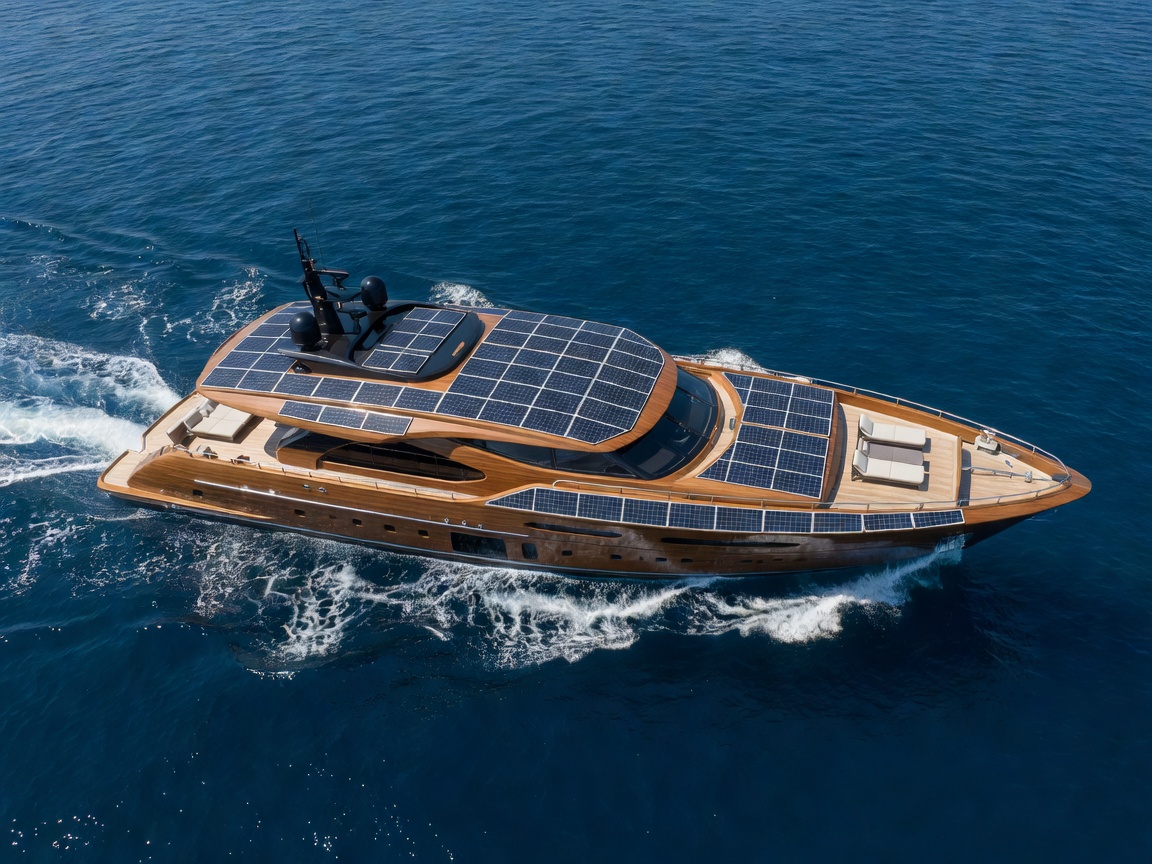
The integration of photovoltaic (PV) technology into superyacht design has moved far beyond the awkward, bolted-on panels of the past. Today's sustainable vessels employ building-integrated photovoltaics (BIPV)—specifically engineered for marine environments—where the solar cells themselves form the structural skin of the bimini, superstructure, and even the hull sides.
Structural and Aesthetic Integration
Superyacht owners demand uncompromised aesthetics. To address this, marine engineers and exterior designers utilize advanced composite materials where ultra-thin monocrystalline or thin-film solar cells are embedded within resins and covered by highly durable, walk-on glass or polycarbonate. This allows decks to generate power while remaining fully functional for guests and crew.
Furthermore, customized coatings can be applied to these panels, altering their color to match the vessel's paint scheme. While this slightly reduces the efficiency of the underlying cells by filtering certain light wavelengths, it allows hundreds of square meters of surface area to be utilized for power generation invisibly.
Yield and Hotel Load Mitigation
It is a common misconception that solar panels can propel a large superyacht. The energy density of sunlight is simply insufficient to drive a 500-ton vessel at 15 knots. However, the primary value of solar integration is in mitigating the "hotel load"—the power required for air conditioning, lighting, galleys, and stabilization systems.
A typical 50-meter yacht might have a baseline hotel load of 100kW. A well-designed solar array covering the hardtop and upper superstructure can generate upwards of 50kW peak during midday in the Mediterranean or Caribbean. When piped directly into the vessel's DC bus, this energy significantly slows the depletion of the battery bank.
In optimal conditions, the combination of a high-capacity battery bank and a large solar array allows a vessel to sit at anchor in complete silence for days. The solar array charges the batteries during the day, covering the base load, while the batteries handle the overnight consumption.
Inverter Technology and Shading
The marine environment presents unique challenges for PV systems, primarily due to complex shading from masts, radar domes, and passing clouds. Traditional solar arrays suffer massive power drops if even a single cell is shaded. Marine installations solve this using micro-inverters or advanced DC optimizers at the panel level.
By treating small clusters of cells independently, the system ensures that shading on one side of the yacht does not drag down the output of the fully illuminated panels on the other side. This sophisticated electrical engineering is crucial for maximizing yield on a dynamically moving and rotating platform.