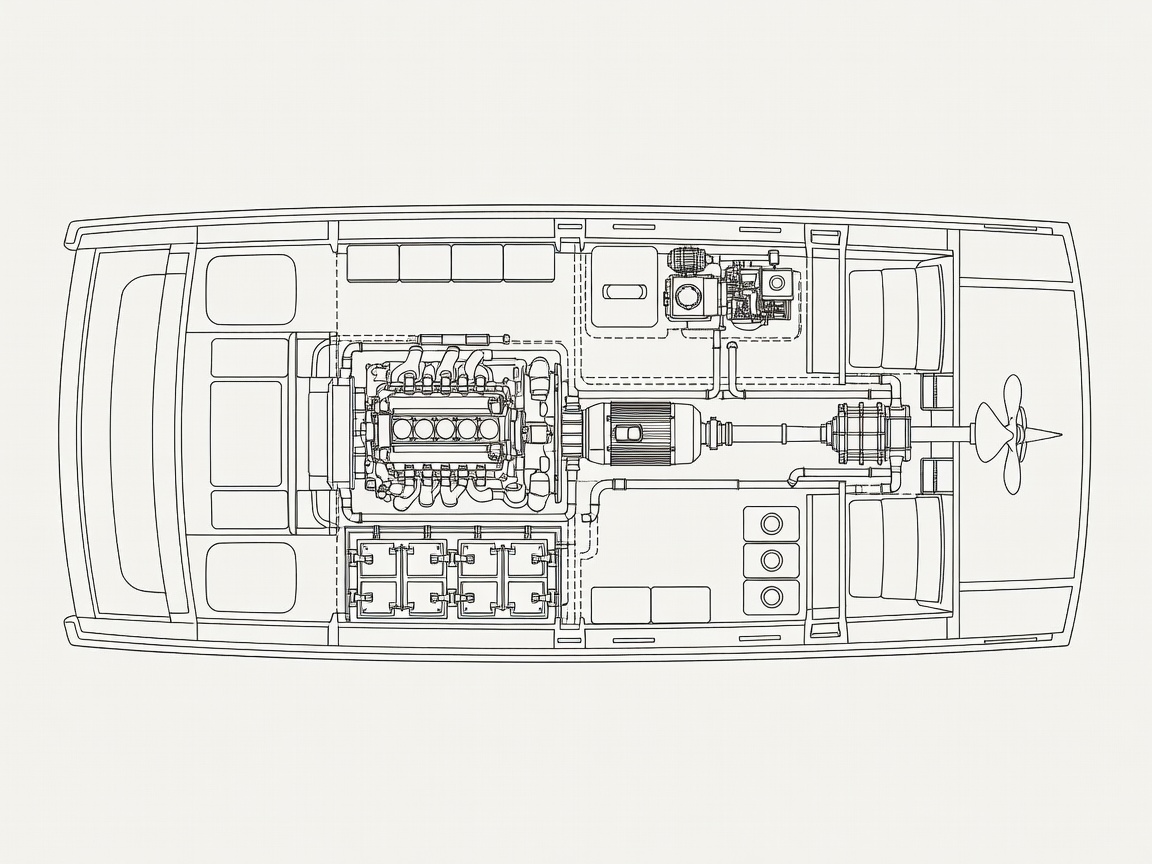
The marine industry is undergoing a systemic shift away from traditional direct-drive diesel propulsion. In the luxury yacht sector, the requirement for silent operation and reduced environmental impact has led to the widespread adoption of hybrid-electric architectures. Navigating the choices between parallel and series hybrid systems requires a deep understanding of the vessel's intended operational profile.
Parallel Hybrid Architecture
In a parallel hybrid configuration, both the internal combustion engine (ICE) and an electric motor are mechanically connected to the propeller shaft. This is typically achieved via a gearbox with multiple power take-in (PTI) and power take-off (PTO) capabilities.
Modes of Operation:
- Diesel-Mechanical Mode: The main engines drive the propellers directly. This is utilized for high-speed cruising or transoceanic crossings where steady, high-power output is required.
- Electric Mode (PTI): The main engines are shut down, and electric motors drive the shafts using energy from the battery bank or auxiliary generators. This allows for silent maneuvering in marinas or environmentally sensitive areas at lower speeds (typically 8 to 10 knots).
- Shaft Generator Mode (PTO): While the main engines drive the vessel, the electric motors run in reverse as generators, drawing off excess mechanical energy to recharge the battery banks and supply hotel loads.
- Boost Mode: Both the diesel engines and electric motors drive the shaft simultaneously to provide maximum thrust, often required for top-speed performance or evasive maneuvering.
The primary advantage of a parallel system is flexibility. It retains the mechanical efficiency of direct diesel drive at high speeds while offering zero-emission capabilities at low speeds. However, it requires significant space in the engine room due to the complex gearbox arrangements.
Series Hybrid Architecture (Diesel-Electric)
In a series hybrid system, there is no mechanical link between the diesel engines and the propellers. Instead, internal combustion engines drive generators to produce electricity, which is fed into a common DC or AC bus. This bus powers both the electric propulsion motors and the vessel's hotel loads. The battery bank is also connected to this bus, allowing for energy storage and retrieval.
This architecture decouples the speed of the diesel engines from the speed of the propellers. The variable-speed generators can run at their most efficient RPM regardless of the vessel's speed, significantly optimizing fuel consumption during low-speed transits. Furthermore, engine room layout becomes highly flexible. Generators can be distributed across the vessel to optimize weight distribution and reduce noise near guest areas.
While historically less efficient at top speeds compared to direct mechanical drives due to conversion losses (mechanical to electrical, then back to mechanical), modern power electronics and permanent magnet motors have closed this gap considerably.
The Power Management System (PMS)
The core of any hybrid superyacht is its Power Management System. The PMS continuously monitors the vessel's power demands—both propulsion and hotel loads—and autonomously starts, stops, or synchronizes generators, or draws from the battery bank to meet the demand efficiently.
Advanced PMS algorithms utilize "peak shaving." When a sudden surge in power is required (e.g., thrusters activating during docking), the PMS rapidly deploys energy from the batteries rather than starting an additional generator. Once the peak demand subsides, the running generators recharge the batteries. This reduces engine running hours, limits thermal stress, and drastically lowers maintenance costs over the vessel's lifecycle.