The regulatory landscape for superyachts has tightened drastically. The International Maritime Organization (IMO) Tier III emission standards mandate a roughly 75% reduction in nitrogen oxide (NOx) emissions compared to Tier II levels for vessels operating in designated Emission Control Areas (ECAs), such as the North American and Caribbean coastlines, and soon the Mediterranean Sea.
Selective Catalytic Reduction (SCR) Systems
To achieve compliance, diesel engines must be fitted with Selective Catalytic Reduction (SCR) systems. SCR technology injects a urea solution (often referred to generically as DEF or AdBlue) into the exhaust stream. When passed over a catalyst, the urea reacts with the harmful NOx gases, breaking them down into harmless nitrogen and water vapor.
While effective, SCR systems are bulky and require the vessel to carry large tanks of urea, consuming valuable interior volume. Integrating an SCR system into a hybrid-electric architecture is highly beneficial. Because the hybrid system utilizes batteries for peak shaving and low-speed operation, the diesel engines run less frequently and at more optimal loads, thereby reducing total fuel burn and consequently lowering the volume of urea required for a given voyage.
Hydrodynamic Hull Optimization
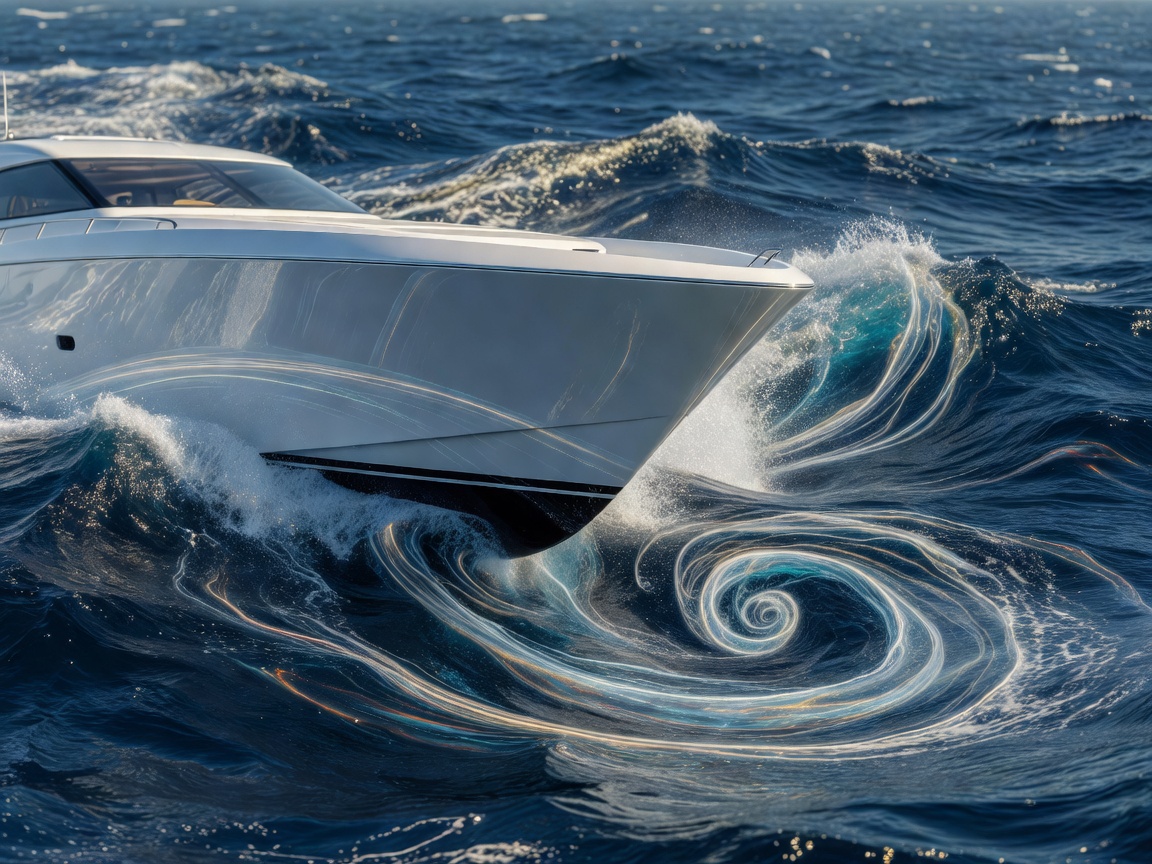
Emission reduction is not solely the domain of engine rooms; it begins with the hull. The traditional heavy displacement hulls of past decades are being superseded by fast-displacement and plumb-bow designs.
Computational Fluid Dynamics (CFD) modeling allows naval architects to refine hull shapes to minimize wave-making resistance and skin friction. Modern fast-displacement hull forms (FDHF) maintain low resistance across the speed curve. A well-optimized hull can reduce required propulsive power by 15% to 20% at cruising speeds compared to a traditional displacement hull.
The Multiplier Effect
The true efficiency of modern yacht design is found in the multiplier effect of combining these technologies. A highly efficient hull requires a smaller propulsion system to achieve the same speed. A smaller propulsion system means less weight, which further reduces drag. When this optimized platform is fitted with a hybrid power management system, the vessel can execute precise load management, running smaller generators at optimal loads rather than running large engines inefficiently.
This holistic engineering approach not only ensures regulatory compliance but provides owners with extended range, lower operating costs, and the ultimate luxury: a quiet, vibration-free environment.